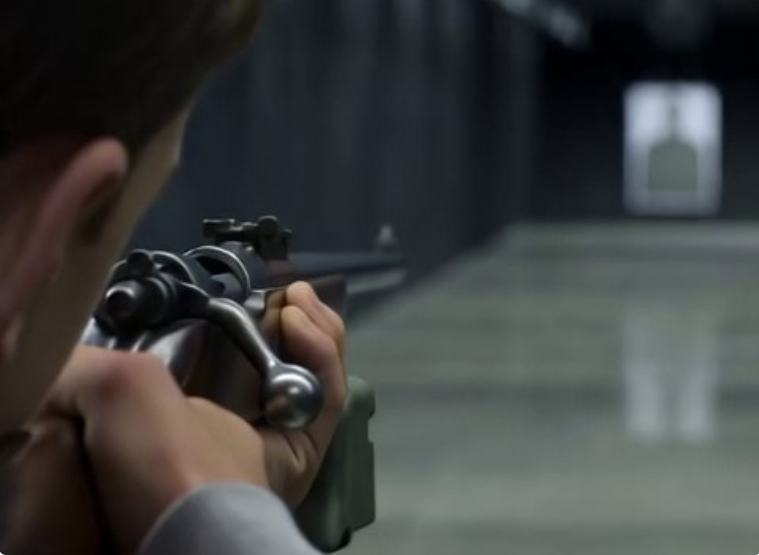
The Courage to Walk Away
A tense encounter becomes a lesson in respect, personal boundaries, and the kind of courage that keeps people safe.
At a shooting range, a teenager faces an intimidating older man whose anger threatens to turn a lesson into a dangerous confrontation. What happens next reveals that real strength is not about controlling others—it is about knowing when to step back and seek help.
STORY · PART 1 OF 5
Part 1: The Challenge

The room was quiet except for the low hum of the lights above the shooting lanes. Ethan, a teenager in a gray hoodie, stood beside the bench with his shoulders tight and his eyes fixed on the floor. Across from him, Marcus—older, stronger, and visibly furious—leaned forward as if the entire room belonged to him.
“You think you can walk away every time things get difficult?” Marcus demanded. Ethan said nothing. He had learned that answering anger with anger only made the situation worse, but his silence seemed to provoke Marcus even more.
A few people at the far end of the range glanced over, then quickly looked away. Ethan felt trapped between the fear of making things worse and the shame of letting someone intimidate him. He had come there hoping to prove he could stay calm under pressure. Instead, the real test had begun before he even touched the equipment.
Marcus pointed toward the bench. “Then show me you’re not afraid.” Ethan looked up at last. He was afraid—but he was beginning to understand that courage was not the same as obeying someone who wanted to control him.
STORY · PART 2 OF 5
Part 2: A Dangerous Lesson

Marcus moved closer, speaking in a low, sharp voice. He treated every hesitation as weakness and every question as an insult. Ethan’s hands curled into fists, then slowly opened again. He remembered a promise he had made to himself: he would never let another person’s temper decide what kind of person he became.
The equipment on the bench suddenly seemed less important than the choice in front of him. He could follow Marcus’s demand simply to end the confrontation, or he could step back and refuse to turn a tense moment into something dangerous.
“Pick it up,” Marcus ordered.
Ethan did not move. His breathing was uneven, but he kept his voice steady. “Not while you’re acting like this.” For a moment, Marcus looked genuinely surprised. He was used to people giving in before they challenged him.
The silence that followed was heavier than the shouting. Ethan had not won an argument, but he had drawn a boundary—and that was the first decision of the day that truly belonged to him.
STORY · PART 3 OF 5
Part 3: The Moment Everything Changed

Marcus’s expression hardened. He struck the bench with his palm, making the objects on it rattle. Several people turned around. An instructor near the entrance began walking toward them, alert to the rising tension.
Ethan stepped away from the bench. He did not reach for anything, and he did not try to match Marcus’s aggression. Instead, he kept a clear distance between them and raised his voice just enough for others to hear.
“I came here to learn,” Ethan said. “I didn’t come here to be threatened.”
The words landed differently in the room. What Marcus had tried to frame as a test of strength was now visible for what it was: intimidation. The instructor arrived and positioned himself between the two, ordering everyone to step back and leave the equipment untouched until the situation was under control.
For the first time, Marcus had an audience he could not silence. Ethan’s decision to pause had given others the chance to intervene before anyone got hurt.
STORY · PART 4 OF 5
Part 4: The Truth Comes Out

The instructor asked each of them to explain what had happened. Marcus tried to dismiss the incident as a misunderstanding, but the witnesses described the shouting and the pressure he had put on Ethan. One person admitted that they had noticed the tension earlier and regretted not speaking up.
Ethan’s voice shook when it was his turn, yet he told the truth without exaggerating. He explained that he had felt unsafe and had refused to handle the equipment while someone was angry beside him. The instructor nodded. Safety rules existed for precisely this reason: no lesson, challenge, or wounded pride was worth risking a life.
Marcus looked away. His anger had carried him so far that he had failed to notice how quickly the situation could have become irreversible.
The instructor suspended the session and made it clear that Marcus would have to answer for his behavior before returning. Ethan was offered time to speak privately with staff and decide whether he wanted to continue another day.
STORY · PART 5 OF 5
Part 5: Real Courage

Outside the range, the afternoon air felt cooler. Ethan sat on a bench and let his hands stop trembling. He had imagined courage as a dramatic moment in which fear disappeared. Now he understood it differently: courage could mean refusing, stepping away, asking for help, or telling the truth when your voice was unsteady.
The incident did not magically solve every problem between him and Marcus. There would be difficult conversations and consequences to face. But Ethan had learned something he would carry with him: respect cannot be forced, and strength is not measured by how much fear someone can create.
Before leaving, he thanked the instructor for stepping in. Then he walked toward the exit with his head held a little higher. He had arrived hoping to prove himself to someone else. He left knowing he did not need to risk his safety to earn anyone’s approval.
Sometimes the bravest choice is not to fight back. It is to stop, set a boundary, and make room for help before a bad moment becomes a tragedy.
The Lesson
Real courage is not reckless defiance. It is recognizing danger, setting a boundary, and giving others the chance to help. No challenge is worth sacrificing safety or dignity.
Aviso legal: El contenido de historiadr.com es únicamente informativo y educacional. No sustituye el consejo, diagnóstico ni tratamiento médico profesional.